
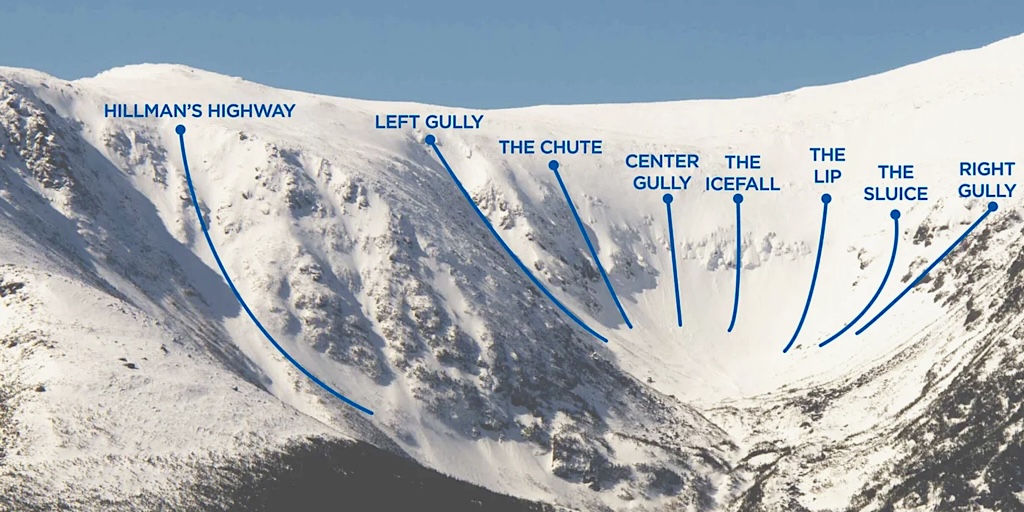
Dodge’s Drop, Lobster Claw, and other sections not shown on this graphic.
With ever-increasing numbers of backcountry skiers and riders year to year, the limits of effectiveness of national, state, and local AIARE and AAI, avalanche awareness campaigns are being reached. “It’s time for a more proactive approach,” said Ivanna Skeemore, a US Forest Service (USFS) spokesperson. “In other words,” she continued, “if these enthusiasts won’t take responsibility for themselves — and they don’t seem to be — we have no choice but to take measures that will passively initiate and better protect these resource users.”
One of the early programs to be tested will be implemented right here in New Hampshire. Specifically this campaign will be centered around activity in Tuckerman Ravine on Mt Washington. The test, to be carried out with cooperation of the Mt Washington Avalanche Center (MWAC), will initially involve the temporary installation of a 155mm M777 Howitzer artillery weapon.
The plan is to mitigate incidental and human-triggered avalanches by triggering them in a controlled manner at the will of the MWAC “Snow Rangers.” This is already a somewhat common practice at some popular front- and back-country ski ares, particularly in the more open western states. The plan on the table is as follows:
In the early morning hours after making their regular in-season assessments, MWAC personnel — if conditions warrant — will aim and fire this artillery weapon at the upper regions of certain couloirs, slope faces, and cornice structures in Tuckerman Ravine. The idea is to release compacted wind-slab mostly found at the upper sections of these locations.
As we understand it, before any shells are to be fired, three warning tones will be sounded during which time the Snow Rangers will be surveying assigned blast areas with binoculars to ensure they’re completely cleared of people. After 15 minutes two more warning tones will sound as a second alert. Five minutes later a third and final tone will be sounded followed by a public address stating “fire in the hole.”
Immediately upon this announcement a single high explosive (HE) cluster-type shell will be sent in a high arc toward its target. The Snow Rangers will allow a few minutes to pass, waiting for the snow to settle so they can visually verify that an avalanche was indeed triggered and the area’s deemed safe. If it is ineffective they will make adjustments as needed and repeat this process, but will shorten the interval between the warning tones and the firing of the shell (assuming the area remains clear).
The initial plan is to test this in specific locations: from Left Gully all the way over to Right Gully. If the trial is successful, the USFS will, with Federal approval, make the installation more permanent, and the MWAC might broaden the effort to include Huntington Ravine. Due to the proposed location of the weapon, Hillman’s Highway, Lobster Class, etc., will not be included. That said, it is possible that a second weapon will be installed but this is to be determined.
Environmentalist are already expressing their concerns but the USFS is reminding those folks that there will be many unaffected areas such as Oakes Gulf, the Eastern Snowfields, Airplane Gully, Great Gully, and others. In other words, the negative impacts will be negligible. “If one life is saved,” Skeemore added, “it’ll be worth it.”
For or against, the public will be invited to comment 60 days prior to the first installation. For details such an exact date, time, and location, please stay tuned for important updates.
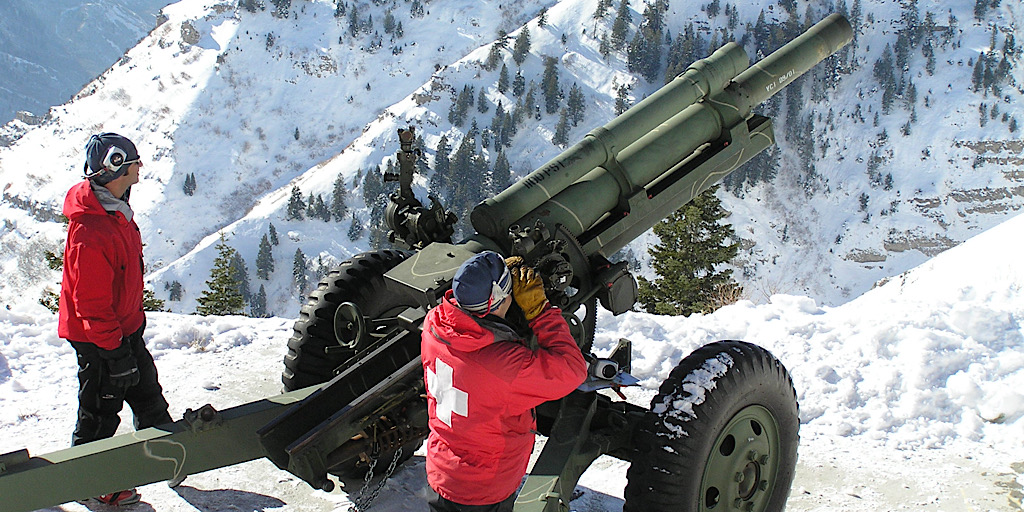
This scene is from Colorado but it offers us an example of the proposed artillery weapon.